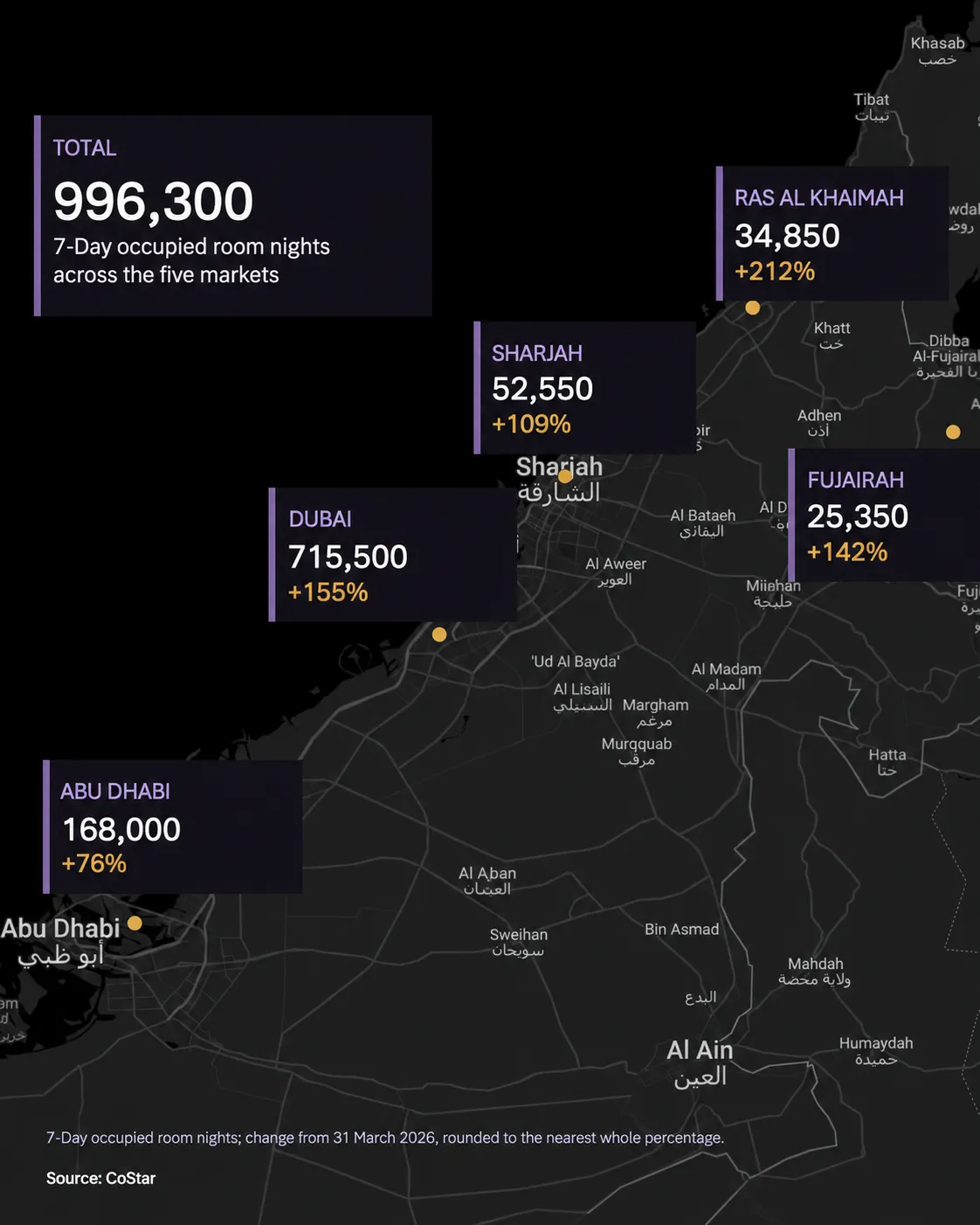
The Sharjah hotel market sold 52,550 occupied room nights in the week to 30 September 2026, up 109% on 31 March 2026, according to CoStar data analysed by Real Estate X. Seven-day room revenue rose 76% over the same period, to AED 10.76m. Because room revenue grew more slowly than room nights, the average rate earned per room night fell over the period.
Key takeaways
- Sharjah's weekly room nights rose 109% between 31 March and 30 September 2026, faster than room revenue, so the average rate earned per room night fell over the period.
- Sharjah room revenue rose 76% from 31 March 2026.
- In the week to 30 September 2026, Sharjah sold more room nights than Ras Al Khaimah (52,550 against 34,850) but earned less room revenue (AED 10.76m against AED 15.95m).
- Fujairah showed the same pattern as Sharjah between 31 March and 30 September 2026, with room nights up 142% and room revenue up 95%.
- Across five markets, seven-day room revenue reached AED 458.2m in the week to 30 September 2026, up 169% on 31 March 2026, according to CoStar data analysed by Real Estate X.
How much has demand in the Sharjah hotel market grown since March 2026?
Weekly demand in the Sharjah hotel market more than doubled between 31 March and 30 September 2026, rising 109% to 52,550 occupied room nights in the week to 30 September 2026, according to CoStar data analysed by Real Estate X. All five markets in this series recovered weekly demand after the disruption in March 2026.
It still sits in the lower half of the group. Of the five markets, only Abu Dhabi recorded a smaller rise in room nights (76%) between 31 March and 30 September 2026, and Abu Dhabi entered the period with seven-day occupancy of 45.0% on 31 March 2026, the highest of the three markets for which we report occupancy. Growth from a high base reads differently to recovery from a low one, as our Abu Dhabi September market update explains. Sharjah has no occupancy figure in this release, so we cannot say where it started.
Why did Sharjah hotel revenue rise more slowly than room nights?
Sharjah's seven-day room revenue rose 76% between 31 March and 30 September 2026, to AED 10.76m, while room nights rose 109% over the same period. Room revenue grew more slowly than room nights, so the average rate earned per room night fell over the period. The data does not say by how much, and we have not estimated it.
Two possible causes fit this pattern, and market-level data cannot separate them. Hotels may have lowered prices to win back guests. Alternatively, more of the recovered demand may have gone to lower-priced hotels, which pulls the market average down even where individual hotels held their rates.
The difference matters to anyone lending against a single Sharjah asset. An owner who discounted has a pricing decision to unwind, while an owner who held rate as the market mix shifted is in a stronger trading position than the market average suggests. The hotel's own rate history since March 2026 is the figure we would ask for first.
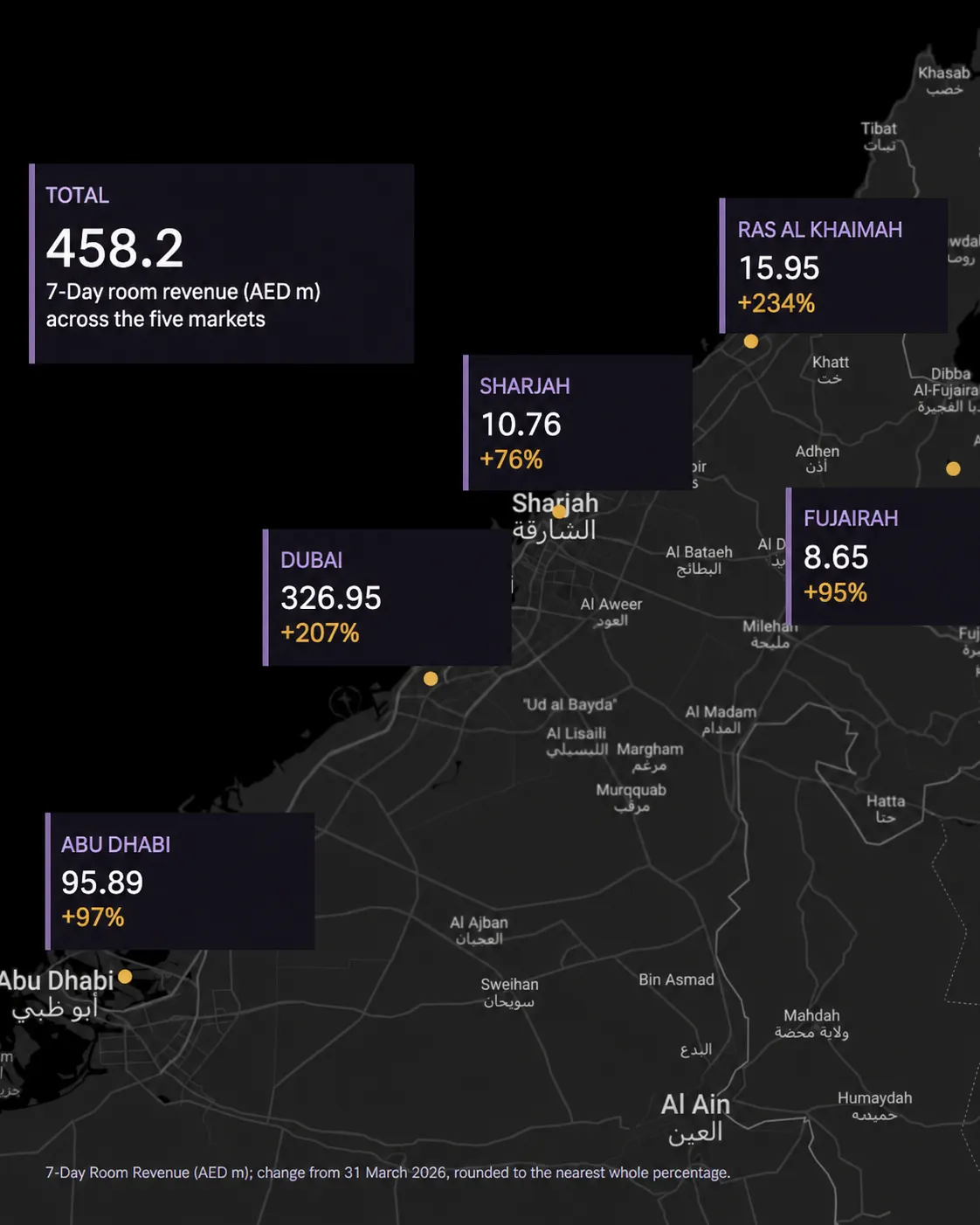
Map of seven-day room revenue across five UAE markets to 30 September 2026, with Sharjah at AED 10.76m, up 76%, and the total up 169%.
How does Sharjah compare with other emirates on hotel demand and revenue?
Sharjah and Fujairah are the only markets of the five where room revenue grew more slowly than room nights between 31 March and 30 September 2026, according to CoStar data analysed by Real Estate X. In Dubai, Abu Dhabi and Ras Al Khaimah, room revenue grew faster than room nights, so the average rate earned per room night rose over the period. Fujairah followed the Sharjah pattern, with room nights up 142% and room revenue up 95%.
Source: Real Estate X analysis. Seven-day occupied room nights and seven-day room revenue as at 30 September 2026, with changes against 31 March 2026 rounded to the nearest whole percentage.
Sharjah against Ras Al Khaimah
In the week to 30 September 2026, Sharjah sold more room nights than Ras Al Khaimah (52,550 against 34,850) but earned less room revenue (AED 10.76m against AED 15.95m). Ras Al Khaimah posted the largest percentage gains of the five markets over the period from 31 March 2026, with room nights up 212% and room revenue up 234%, though on a small base. Ranked by volume and ranked by revenue, the two markets swap places. For a lender, revenue sits closer to debt service, and our Ras Al Khaimah hotel market review covers that market's monthly trading.
Source: Real Estate X analysis. Seven-day figures as at 30 September 2026, with changes against 31 March 2026.
Sharjah against Dubai
Dubai is Sharjah's neighbour and by far the largest of the five markets, with 715,500 room nights and AED 326.95m of room revenue in the week to 30 September 2026. Dubai's room revenue rose 207% against 31 March 2026, faster than its room nights (155%), so the average rate earned per room night in Dubai rose over the period. On rate, the two neighbouring markets moved in opposite directions. We find that the most striking point in the Sharjah data, and our Dubai September hotel performance analysis covers the Dubai recovery in full.
What does a volume-led recovery mean for Sharjah hotel valuation and lending?
A recovery led by volume converts to profit more slowly than one led by price, because a room sold at a lower rate carries the same servicing costs. In Sharjah, room nights rose 109% and room revenue rose 76% between 31 March and 30 September 2026, and it is revenue, carried through to profit, that pays interest.
Security is not serviceability. Loan-to-value tests what a hotel is worth, and interest cover tests what it earns. In 2026 the two came apart, so a Sharjah hotel can hold its Market Value and still face pressure on a covenant test run on trailing earnings. Valuation should show the lender that difference.
On a trade-related asset such as a hotel, a profits-based figure can reflect the property, the business operating within it, and the performance of one operator. Only one of those is Market Value. We cross-check profits-based valuations against other approaches and market evidence, which matters more where the market rate has fallen for reasons not yet clear.
Our recovery modelling starts with the undisrupted base, meaning what the asset would have earned had the disruption not occurred. We then follow the evidence by benchmarking recovery, tracking source markets and observing rate movement, and model the convergence. Our approach to modelling hotel recovery sets out the method, and the assumptions are meant to be visible and open to challenge.
Where a valuation carries a material uncertainty clause, four questions apply: what specifically is uncertain, what it changes, what it does not change, and when it comes off. The clause is there to help you weight the figure. Real Estate X holds RICS and RERA registration and works with more than 30 banks across the UAE on commercial and hospitality valuations.
"Sharjah has filled rooms faster than it has recovered price. A lender should care more about the second, because interest is paid out of what each room earns, and a busier hotel is not automatically a safer loan."
Four questions a lender or owner should ask of a Sharjah hotel:
- Has this hotel's own average rate fallen since the disruption in March 2026, or has it held rate while the wider market mix shifted?
- Which segments and source markets account for the hotel's recovered room nights, and how much of that business is contracted at fixed rates?
- Does the valuation separate the property from the business and the operator, and has the profits-based figure been cross-checked against market evidence?
- If interest cover is tested on trailing earnings, how much of the weaker trading period still sits inside the test, and when does it drop out?
How we read the data
All Sharjah figures in this note are CoStar data analysed by Real Estate X, as at 30 September 2026. We compare seven-day occupied room nights and seven-day room revenue (in AED millions) at 30 September 2026 with the same seven-day measures at 31 March 2026. CoStar rounds these seven-day percentage changes to the nearest whole percentage, and we quote them exactly as given. Our recovery forecasts in this series cover Dubai, Abu Dhabi and Ras Al Khaimah, and we have issued no forecast for Sharjah.
What this data cannot tell you
This release holds no occupancy, hotel supply, revenue per available room (RevPAR) or monthly data for Sharjah, so we cannot say how full Sharjah hotels were in September 2026 or how the market moved month by month. There is no average daily rate (ADR) in the data, and we have not derived one. A falling average rate may reflect a change in which hotels are selling, and need not mean that individual hotels cut their prices. The data comes from sources we consider reliable but cannot guarantee, forward-looking statements carry risk, other consultancies may hold different views, and nothing here is investment advice.
Frequently asked questions
What is the difference between hotel demand and hotel revenue?
Hotel demand counts occupied room nights, meaning the number of rooms sold. Hotel revenue measures what those rooms earned. In the week to 30 September 2026, Sharjah sold 52,550 room nights and earned AED 10.76m in room revenue, according to CoStar data analysed by Real Estate X. When demand grows faster than revenue, the average rate per room night falls.
How many hotel room nights does Sharjah sell in a week?
Sharjah hotels sold 52,550 occupied room nights in the week to 30 September 2026, according to CoStar data analysed by Real Estate X. That was 109% more than on 31 March 2026. Sharjah sold more room nights than Ras Al Khaimah (34,850) and Fujairah (25,350) in the same week, and far fewer than Dubai.
Is Sharjah hotel revenue recovering?
Yes, though more slowly than demand. Sharjah's seven-day room revenue reached AED 10.76m in the week to 30 September 2026, up 76% on 31 March 2026, while room nights rose 109% over the same period. Because revenue grew more slowly than room nights, the average rate earned per room night fell.
Is there hotel occupancy data for Sharjah for September 2026?
Not in this release. The Real Estate X data for Sharjah covers seven-day room nights (52,550, up 109%) and seven-day room revenue (AED 10.76m, up 76%) as at 30 September 2026, against 31 March 2026. There is no Sharjah occupancy, RevPAR, monthly figure or forecast, and we do not estimate one.
Can a Sharjah hotel hold its value if its average rate falls?
It can. Loan-to-value tests what a hotel is worth, interest cover tests what it earns, and in 2026 the two came apart. With Sharjah room revenue up 76% against room nights up 109% between 31 March and 30 September 2026, lenders should test cash flow and covenants as closely as Market Value.
Which emirate had the largest rise in hotel demand since March 2026?
Ras Al Khaimah recorded the largest rise of the five markets, with seven-day room nights up 212% between 31 March and 30 September 2026, according to CoStar data analysed by Real Estate X. Its volume remains small, at 34,850 room nights in the week to 30 September 2026. Sharjah rose 109% to 52,550 room nights over the same period.


Explore Our Latest Insights
This blog explores the importance of surrounding yourself with like-minded individuals, mentors, and networks that can provide guidance, encouragement