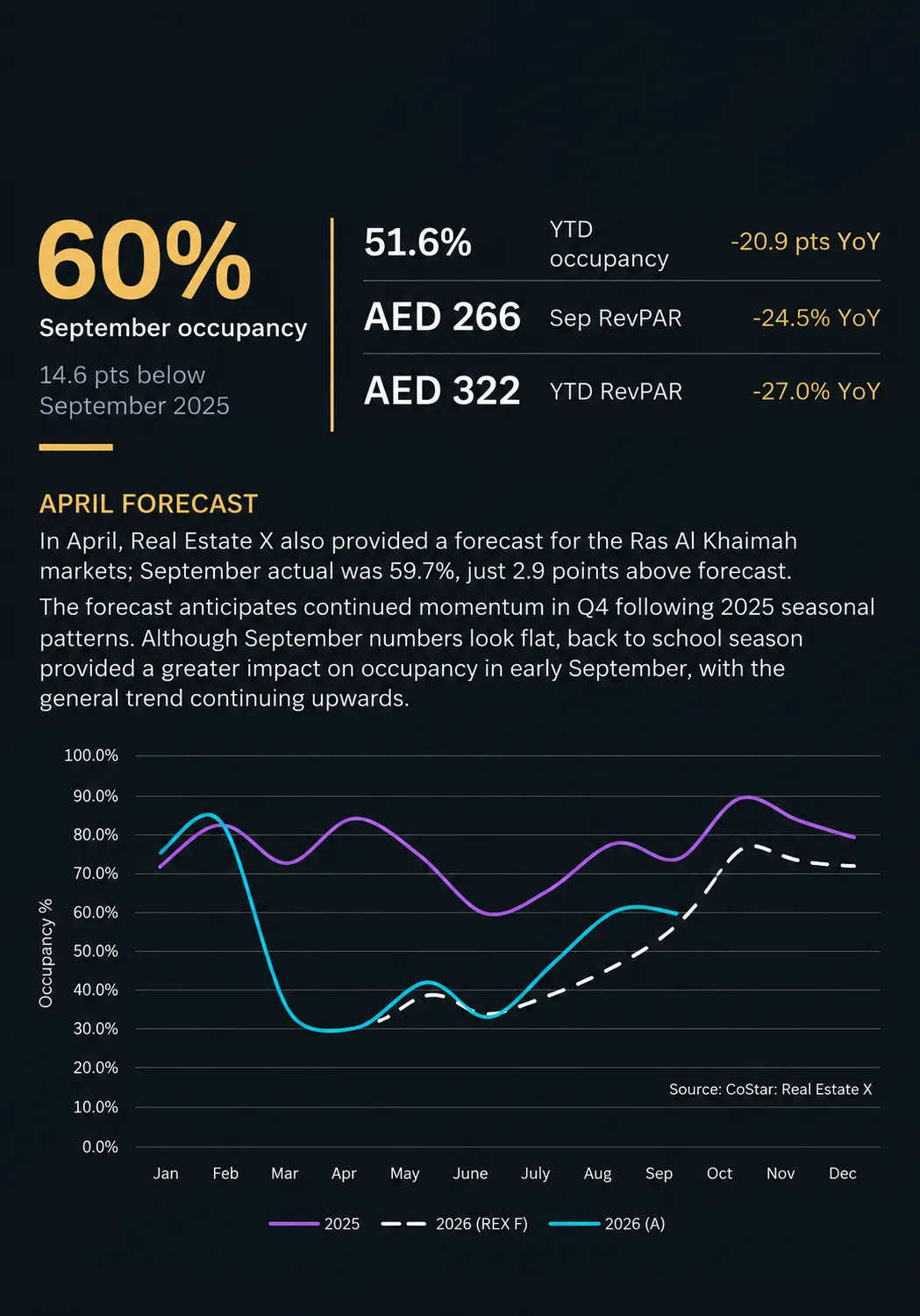
Ras Al Khaimah hotel occupancy rose from 19.8% in the week to 31 March 2026 to 66.2% in the week to 30 September 2026, the largest gain of the three markets tracked in CoStar data analysed by Real Estate X. Monthly occupancy for September 2026 was 59.7%, 2.9 points above our April forecast, but revenue per available room (RevPAR) of AED 266 was still 24.5% below September 2025.
Key takeaways
- Weekly occupancy reached 66.2% by 30 September 2026.
- Between 31 March 2026 and 30 September 2026, Ras Al Khaimah's seven-day occupancy climbed 46.4 percentage points from a low of 19.8%, the largest gain of the three markets in CoStar data analysed by Real Estate X.
- September 2026 occupancy of 59.7% beat our April forecast by 2.9 points but sat 14.6 points below September 2025.
- RevPAR was AED 266 for September 2026, down 24.5% year on year, and year to date (YTD) RevPAR to September 2026 was AED 322, down 27.0%.
- Room revenue in the week to 30 September 2026 was AED 15.95m, up 234% on the week to 31 March 2026, the largest rise of the five markets, though from a small base.
What was Ras Al Khaimah hotel occupancy in September 2026?
Ras Al Khaimah hotel occupancy was 59.7% for September 2026, according to CoStar data analysed by Real Estate X. That was 14.6 points below September 2025 and 2.9 points above the forecast Real Estate X provided in April 2026.
Earnings have further to go. YTD occupancy to September 2026 stood at 51.6%, down 20.9 points year on year, while September 2026 RevPAR of AED 266 was 24.5% below the same month in 2025. YTD RevPAR to September 2026 was AED 322, down 27.0% year on year.
So the market beat our occupancy forecast in September 2026 while its earnings stayed well behind 2025. For a lender, the distance between those two readings is the story of Ras Al Khaimah in 2026.
Source: Real Estate X analysis. YoY means year on year, against the same period of 2025.
How far has Ras Al Khaimah hotel occupancy recovered since March 2026?
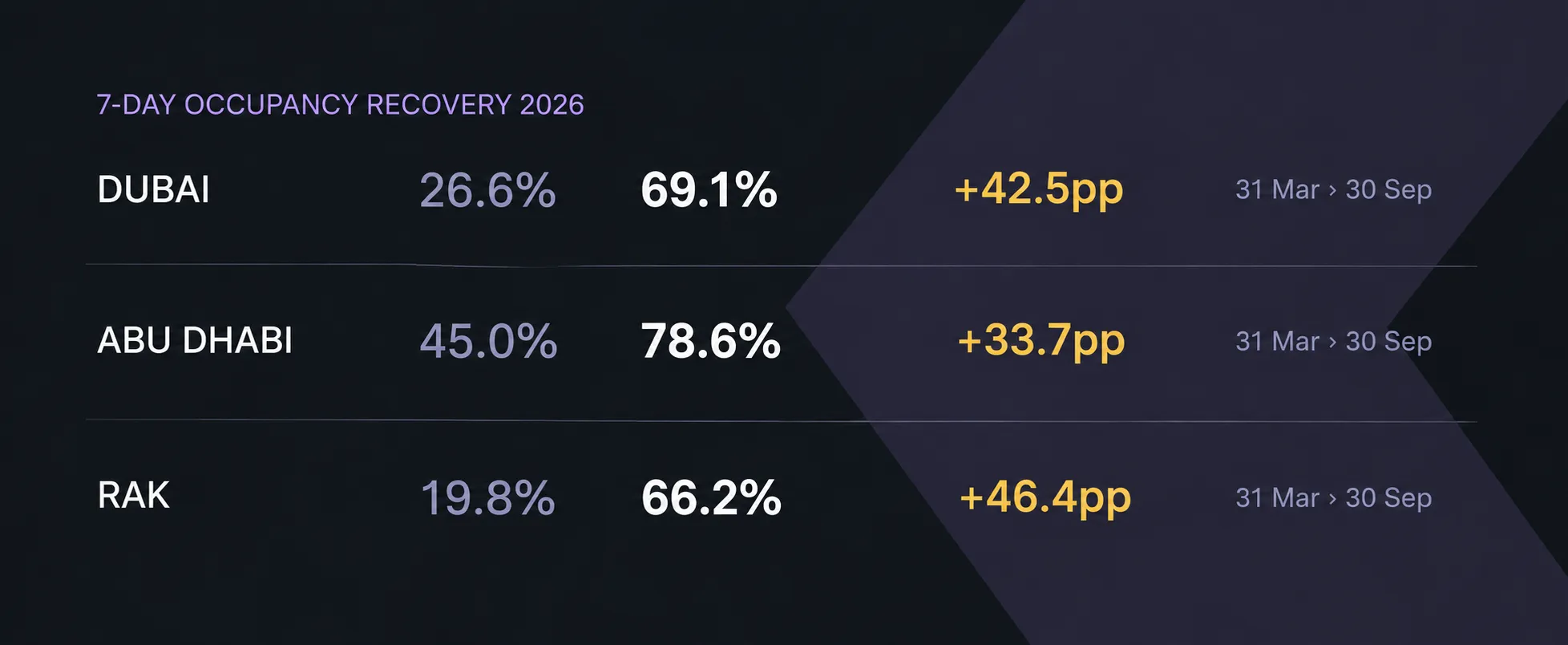
Seven-day occupancy in Ras Al Khaimah rose from 19.8% in the week to 31 March 2026 to 66.2% in the week to 30 September 2026, a gain of 46.4 percentage points. It started from the lowest point of the three markets in the CoStar data analysed by Real Estate X and made the largest gain.
Between 31 March 2026 and 30 September 2026, Dubai gained 42.5 points and Abu Dhabi 33.7 points, as set out in our Dubai hotel occupancy analysis and our Abu Dhabi September market note. Even so, Ras Al Khaimah still had the lowest seven-day occupancy of the three in the week to 30 September 2026, at 66.2% against 69.1% in Dubai and 78.6% in Abu Dhabi. The speed of the climb is striking, and the level it has reached still trails both larger markets.
Source: Real Estate X analysis. Seven-day occupancy for the week to each date. pp means percentage points.
What do seven-day revenue and room nights show for the RAK hotel market in 2026?
In the week to 30 September 2026, Ras Al Khaimah hotels earned AED 15.95m in room revenue, up 234% on the week to 31 March 2026, and sold 34,850 occupied room nights, up 212%. Both were the largest percentage gains of the five markets in the CoStar data analysed by Real Estate X.
Scale matters here. In the week to 30 September 2026, Dubai earned AED 326.95m in room revenue from 715,500 room nights, so Ras Al Khaimah's gains sit on a far smaller base, where a single large resort can move the total. Our note on the Sharjah hotel market covers the other smaller market in this series.
Between the weeks to 31 March 2026 and 30 September 2026, Ras Al Khaimah room revenue grew faster than room nights (234% against 212%), which means the average rate earned per room night rose over the period. This data publishes no rate, so we would not put a size on that movement.
Why does September 2026 look flat for Ras Al Khaimah?
The monthly occupancy figure of 59.7% for September 2026 understates where the market ended the month. Our view is that although the September 2026 numbers look flat, back to school season had a greater impact on occupancy in early September, with the general trend continuing upwards.
The seven-day data supports that reading. Occupancy in the week to 30 September 2026 was 66.2%, higher than the 59.7% recorded for September 2026 as a whole, which is consistent with softer trading early in the month and firmer trading by its close.
For credit work, the end-of-month weekly figure is the one we would ask for first. A monthly figure can hide the direction of travel inside the month.
Is Ras Al Khaimah a different kind of hotel market from Dubai and Abu Dhabi?
On the shape of its 2026 monthly occupancy line, yes. In the REX market performance chart built on CoStar data, Ras Al Khaimah began 2026 slightly above 2025 in January and February, and its monthly line is choppier than those of Dubai and Abu Dhabi, which fits a resort-led leisure market.
Occupancy fell sharply in March 2026 in all three markets. Since then, the Ras Al Khaimah 2026 actual line has sat below the 2025 line in every month from March to September, and it ran above our forecast line in July, August and September 2026.
There is a gap in what we can show. The CoStar segment data in this series covers only Dubai and Abu Dhabi, for July and August 2026, so we cannot say how transient, group and contract demand have moved in Ras Al Khaimah. That matters, because in Dubai group demand rose 45.3% between July and August 2026, and group business books months ahead.
What is the RAK hotel occupancy forecast for Q4 2026?
Our forecast for Ras Al Khaimah anticipates continued momentum in Q4 2026, following 2025 seasonal patterns. In the REX chart, the Ras Al Khaimah forecast line rises into the fourth quarter on the 2025 seasonal shape, as the Dubai and Abu Dhabi lines do.
We have not published a Ras Al Khaimah forecast value in this note. What we can say is that September 2026 occupancy came in 2.9 points above the April forecast, and the actual line has run above forecast in each month since July 2026. In a market this size we would read that as a direction of travel, and test each asset against its own trading.
What does the Ras Al Khaimah recovery mean for hotel valuation and lending?
For lenders, the Ras Al Khaimah recovery in occupancy has not yet carried through to earnings, with YTD RevPAR to September 2026 down 27.0% year on year. Security is not serviceability. Loan-to-value tests what the asset is worth and interest cover tests what it earns, and in 2026 the two came apart.
A Ras Al Khaimah hotel can hold its Market Value and still face covenant pressure, because trailing covenant tests look back over the months of disruption. Market Value and cash flow answer different questions, and a valuation should show the difference. On a trade-related asset such as a hotel, a profits-based figure can reflect the property, the business operating within it and the performance of a single operator, and only the property is Market Value. We cross-check profits-based valuations against other approaches and market evidence.
Our approach to recovery, set out in our paper on how we model hotel recovery, starts with the undisrupted base: what the asset would have earned had the disruption in March 2026 not occurred. We then follow the evidence through benchmark recovery, source markets and rate movement, and model the convergence of different recovery speeds towards the same structural destination. The aim is auditability, with assumptions that are visible and open to challenge.
Real Estate X is RICS and RERA registered and works with more than 30 banks across the UAE, and our commercial valuation work includes specialist experience in hospitality, education and industrial assets.
"Ras Al Khaimah has moved further than Dubai or Abu Dhabi since March, but a covenant is tested on earnings, and earnings here are still well short of 2025." Dan Harrison MRICS
Four questions a lender or owner should ask of a Ras Al Khaimah hotel:
- What would this hotel have earned had the disruption in March 2026 not occurred, and what evidence supports that undisrupted base?
- How does the asset's trailing income sit against its interest cover covenant, tested separately from its loan-to-value position?
- With no segment split published for Ras Al Khaimah, how much of this asset's recovery depends on a single source market or a single events calendar?
- If the valuation carries a material uncertainty clause, what specifically is uncertain, what does it change, what does it not change, and when does it come off?
How we read the data
All occupancy, RevPAR, room revenue and room night figures in this note are CoStar data analysed by Real Estate X, with data as at 30 September 2026. Monthly figures for September 2026 are compared with September 2025, and YTD figures with the same period of 2025. Seven-day figures compare the week to 30 September 2026 with the week to 31 March 2026, and the Ras Al Khaimah forecast is the one Real Estate X provided in April 2026. CoStar rounds the seven-day percentage changes to whole numbers.
What this data cannot tell you
Ras Al Khaimah is a small market, and a single resort opening, closing or changing how it trades can move the average. There is no segment split for Ras Al Khaimah in this data and no average daily rate is published here, so we cannot say which demand drove the recovery or how far rates have moved. The seven-day figures are snapshots of a single week and can be lifted or held back by events and calendar timing. The data comes from sources considered reliable but not guaranteed, forward-looking statements carry risk, other consultancies may hold different views, and nothing here is investment advice.
Frequently asked questions
What is RevPAR, and why does it matter more than occupancy to lenders?
Revenue per available room (RevPAR) is room revenue divided by the number of rooms available, so it reflects both how full a hotel is and what it earns from its rooms. In Ras Al Khaimah, RevPAR for September 2026 was AED 266, down 24.5% year on year, according to CoStar data analysed by Real Estate X.
How does Ras Al Khaimah hotel occupancy compare with Dubai and Abu Dhabi?
In the week to 30 September 2026, Ras Al Khaimah recorded seven-day occupancy of 66.2%, against 69.1% in Dubai and 78.6% in Abu Dhabi. It started lowest of the three, at 19.8% in the week to 31 March 2026, and made the largest gain, according to CoStar data analysed by Real Estate X.
Is Ras Al Khaimah RevPAR back to 2025 levels?
Not yet. Ras Al Khaimah RevPAR was AED 266 for September 2026, 24.5% below the same month in 2025, and AED 322 for the year to date, down 27.0% year on year. Occupancy has recovered faster than earnings, which is why we treat cash flow and Market Value as separate questions in 2026.
How accurate was the Real Estate X forecast for Ras Al Khaimah?
For September 2026, actual Ras Al Khaimah occupancy of 59.7% came in 2.9 points above the forecast Real Estate X provided in April. The actual line also ran above the forecast in July and August 2026, and our forecast anticipates continued momentum in Q4 following 2025 seasonal patterns.
Why are Ras Al Khaimah's percentage gains so much larger than Dubai's?
The base is small. Seven-day room revenue in Ras Al Khaimah rose 234% to AED 15.95m and room nights rose 212% to 34,850 in the week to 30 September 2026, against the week to 31 March 2026. Dubai's gains were smaller in percentage terms but came on AED 326.95m of room revenue.
How should lenders approach resort hotel valuation in the UAE in 2026?
Test value and earnings separately. Loan-to-value tests what a resort is worth and interest cover tests what it earns, and in Ras Al Khaimah YTD RevPAR to September 2026 was still 27.0% below 2025. Real Estate X is RICS and RERA registered and works with more than 30 banks across the UAE.


Explore Our Latest Insights
This blog explores the importance of surrounding yourself with like-minded individuals, mentors, and networks that can provide guidance, encouragement